 English
  Tiếng Việt
 In today's digital age, the Internet of Things (IoT) is transforming every field, from industry, healthcare to transportation, agriculture, and urban management. However, one of the biggest challenges in implementing IoT is the requirement for stable internet connectivity and high bandwidth, especially in remote areas where traditional infrastructure like fiber optic or mobile networks cannot reach. And this is where satellite internet service plays an important role. So, can satellite internet service support IoT connectivity? Let's explore the answer in the article below.
satellite internet
1. Satellite Internet – A New Solution for Global Connectivity
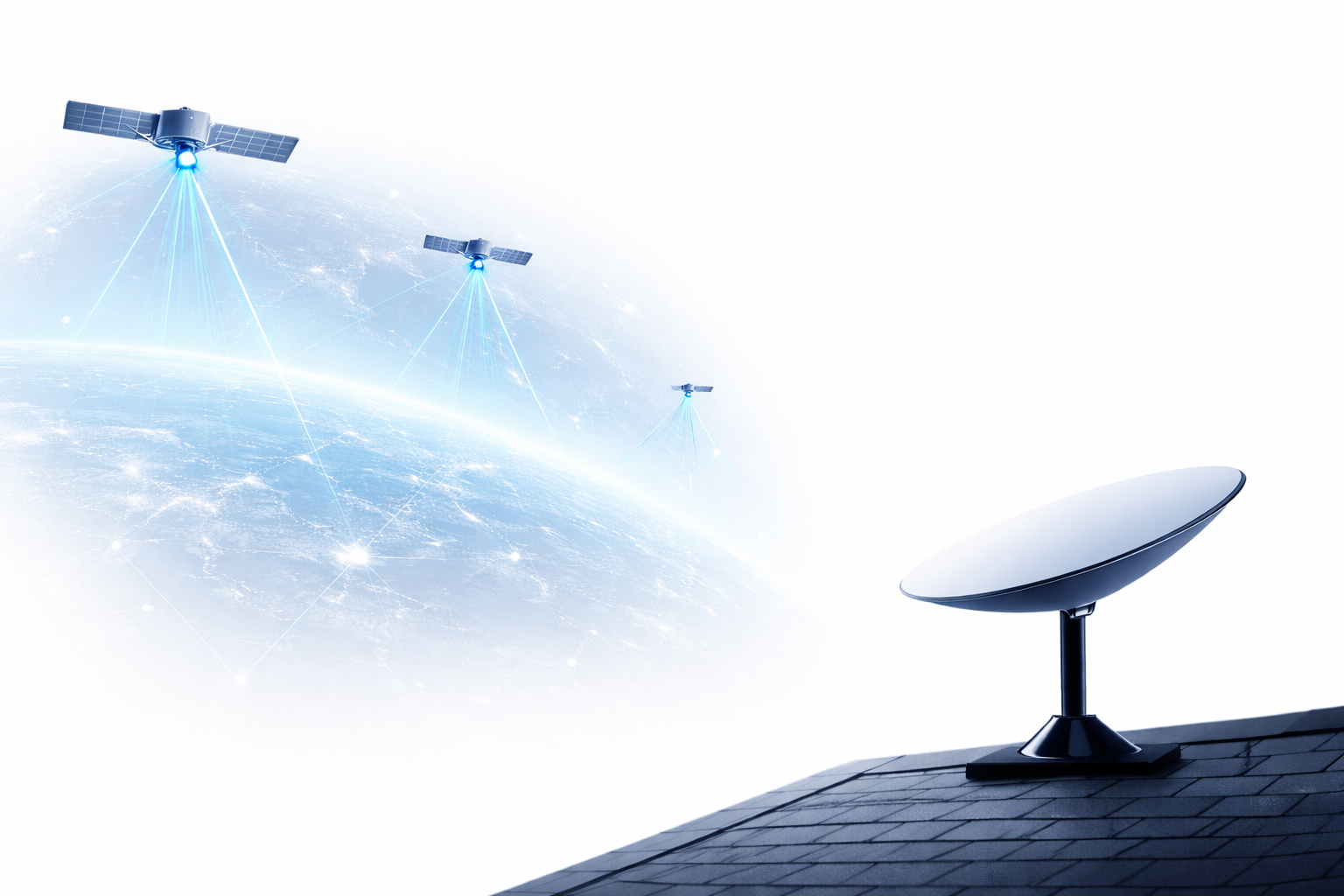
Satellite internet is a technology that transmits internet through low Earth orbit (LEO), medium Earth orbit (MEO), or geostationary Earth orbit (GEO) satellites instead of traditional fiber optic cables or mobile networks. Companies like SpaceX (Starlink), Amazon (Project Kuiper), or OneWeb have expanded their satellite networks, providing high-speed satellite internet services with global coverage.
This service is particularly useful for areas lacking stable internet infrastructure, such as rural areas, remote islands, or difficult terrains. Satellite internet not only provides connectivity for individual users but also opens up numerous opportunities for IoT applications, from smart agriculture solutions to environmental monitoring systems.
2. IoT – Unlimited Connectivity Network
Internet of Things (IoT) is an ecosystem of smart devices connected to each other via the internet to collect and share data. IoT devices can be environmental sensors, smart home appliances, self-driving cars, or industrial monitoring systems. The goal of IoT is to make everything around us "smarter", easier to monitor and control remotely.
To achieve this, a stable and fast internet connection is essential. Especially as IoT grows with billions of devices, unlimited connectivity is a crucial factor. Satellite internet service can be an optimal solution when ground network infrastructure is not strong enough to support the rapid development of IoT.
3. Satellite Internet and IoT: A Close Relationship
Satellite internet service can greatly support IoT applications, especially in areas where ground network infrastructure is unavailable or cannot be deployed. Here are the reasons why satellite internet is suitable for IoT:
a. Global Coverage: From Cities to Remote Areas
One of the biggest advantages of satellite internet is its global coverage, regardless of geography. Low Earth Orbit (LEO) satellites like those of Starlink provide extensive coverage in remote areas, islands, or even disaster-stricken regions where internet connectivity via fiber optics or 4G/5G is inaccessible.
For IoT, this means a lot. IoT solutions in agriculture, environmental monitoring, remote healthcare, or even wildlife tracking can operate smoothly thanks to satellite connectivity, not limited by local infrastructure.
b. Minimize Infrastructure Installation Costs
Deploying fiber optic or 4G/5G mobile network infrastructure to remote areas can be very costly, especially in regions with low population density. In contrast, satellite internet service can be easily deployed with just a few simple terminal devices like a satellite antenna and modem, saving significant costs.
This is particularly important for deploying IoT solutions in unconnected areas or for projects requiring rapid deployment without excessive investment in physical infrastructure.
c. High Bandwidth and Update Speed
Satellite internet today is capable of providing high bandwidth and fast transmission speeds, sufficient to support IoT applications that require rapid data transmission such as video surveillance, real-time sensor data collection, or remote device control. Low Earth Orbit (LEO) satellites like Starlink's offer bandwidth speeds of up to 100 Mbps or more, enabling seamless and uninterrupted connection of IoT devices.
d. Reliability and Stability
Although satellite internet can be affected by weather factors (rain, storms), modern satellite technology has helped minimize disconnections. With low-Earth orbit satellites, latency has been significantly improved, providing more stable connections compared to previous high-Earth orbit satellites.
4. Challenges of Connecting IoT via Satellite Internet
Although satellite internet is an effective solution for IoT connectivity, some challenges still exist:
a. Higher Latency Than Traditional Networks
Satellite internet is still affected by latency as the signal has to travel through satellites. Although new satellite technology has helped reduce latency, in some IoT applications requiring immediate feedback, such as automated control or remote medical monitoring, latency can still cause problems.
b. Initial Setup Costs
Although the cost of terminals and services has decreased significantly compared to before, the initial cost of setting up satellite internet connection can still be high for some users. This can be a barrier for small businesses or areas with limited resources.
c. Weather Conditions Affecting Connection
As mentioned, satellite internet can be affected by weather factors such as rain, storms, or snow. While this is not a major issue in most areas, for applications requiring high accuracy and continuous operation, this needs to be taken into account.

, the satellite project founded by
5. Conclusion
Satellite internet services have become an important part of connecting IoT devices, especially in remote and isolated areas where traditional infrastructure cannot reach. Current satellite technologies not only provide stable internet connectivity but also help save costs and enhance the efficiency of IoT applications in many fields.
Despite some challenges, such as latency and setup costs, with the continuous development of satellite technology, Satellite Internet will undoubtedly be one of the leading solutions for connecting and deploying IoT solutions in the future.